


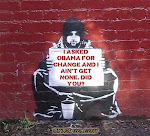


"What? You thought that the 2008 Presidential Election proved that America is not a racist country when we elected a black President when only one out of eight Americans are black? On the contrary, that election proved we are very much a racist country. Let's take a look at why Obama got elected. Was it because of his sterling record of accomplishment and his clear abilities to lead? That question answers itself because his resume would fit on the back of a postage stamp. Was it because he showed a knack for picking the right people to give him advice? A quick look at his choice of mentors like Bill Ayers, Jeremiah Wright and Tony Recko refutes that notion. He has continued showing a poor choice in choosing his associates as his various czars bear witness.
"Then look at what people seemed to admire in him. His rhetorical abilities to read a good speech and to pick good speechwriters might be a reasonable choice. Was that enough to pick him to be the most powerful man in the world? Come on, people, let's face it, he was picked because of the color of his skin and just about nothing else because there was nothing there other than that. Picking on or choosing people based on their skin color is a racist act. That is what an large amount of the American electorate did and that makes this a racist country.
"Now to be sure about 30% of the voters would vote for the donkey if the Democrats ran it but what about the other 23%? Yes, some of them fell for the hope and change gambit because Obama is the quintessential conman. Yes, some people voted not for Obama but against McCain and/or Palin. None of these can explain the entire 23%. Let's look at which part of the electorate that voted for Obama who usually do not bother to vote based on historical trends. The clear answer is the blacks and the under 30 group. They turned out in droves for Obama. Why did they suddenly do that? It is hard to come up with any other explanation but the color of Obama's skin.
"Now that is not to say that most of these folks had other motives besides just the color of his skin. White guilt about this country ever condoning slavery comes to mind. Perhaps some thought that doing this would prove that America is not a racist country when it had the exact opposite effect. Perhaps others just like supporting the 'disadvantaged' people in this country. None of these motives disguise the fact that they made a racist tinged decision. This was what could be rightly called the ultimate affirmative action. The fact that affirmative action is reverse racism does not make it any less racist.
"Let's face facts: both Obama and his wife have been affirmative action bonus babies their entire lives. They have had everything handed to them on a silver platter primarily because of the color of their skin. Who paid for their expensive college education at top flight schools? It certainly was not them. Did they get passing grades in school based on their merit or was the color of their skin factored in? Perhaps this is why Obama's college records are sealed? Did they get jobs because they were the best qualified candidates or because they were filling a racial quota? Who knows, but the suspicion remains based on their attitudes. Like most people who get something they do not deserve, they resent it. This might explain why neither of them seems to be either grateful for living here or being proud of their country.
"I am well aware that this little opinion piece is going to get me called a racist, but somebody had to say it and I just did. It will not be the first time nor will it be the last time. Over thirty-five years ago, four U. S. Senators stood on the capitol steps and told the assembled media that I was plainly a racist. Why did Senators Ted Kennedy, Birch Bayh, Phil Hardt and Alan Cranston do that? It was because I refused to buckle to the demands of Cesar Chavez and his gang of thugs to help them recall the Governor of Arizona. That led to an FBI investigation that showed no evidence of that but that part never got publicized unlike the attack on me personally. Still I will be in the good company of the town hall protesters and the tea party folks who also got called racists without any evidence to support it other than a few signs held up by people who were not even part of the protest.
"Of course, calling Republicans racists is pretty much par for the course and has been ever since 1964 when it was applied to Barry Goldwater and his supporters like me. You did not hear Republicans called racists prior to that because the blatant racists were the Southern Democrats who voted against every piece of civil rights legislation ever proposed while the Republicans were by and large supporting them. This certainly included Lyndon Baines Johnson prior to 1960 but you never heard a peep about that because those real racists were all Democrats. They can even be members of the Klu Klux Klan and still be elected to the U. S. Senate. This double standard about racism has been with us for over 55 years now and is still going strong."
Wednesday, January 27, 2010


The Antiwar Peace Movement Needs a Restart
"In his first year President Obama broke several war-making records of President George W. Bush. He passed the largest military budget in US history, the largest one-year war supplementals and fired the most drone attacks on the most countries. He began 2010 asking for another $30 billion war supplemental and with the White House indicating that the next military budget will be $708 billion, breaking Obama's previous record.
"While some commentators on MSNBC hailed Obama as the peace candidate, he has done more for war in a shorter time than many other commanders in chief. US attacks on other countries are not challenged in any serious way even if they result in consistent loss of innocent civilian life. It is not healthy for American democracy to allow unquestioned militarism and put war budgets on a path of automatic growth despite the US spending as much as the rest of the world combined on weapons and war.
Antiwar opposition has failed and needs to begin anew."
"While some commentators on MSNBC hailed Obama as the peace candidate, he has done more for war in a shorter time than many other commanders in chief. US attacks on other countries are not challenged in any serious way even if they result in consistent loss of innocent civilian life. It is not healthy for American democracy to allow unquestioned militarism and put war budgets on a path of automatic growth despite the US spending as much as the rest of the world combined on weapons and war.
Antiwar opposition has failed and needs to begin anew."
From a Liberal Website: "Obama's Credibility Gap"
"Mr. Obama may be personally very appealing, but he has positioned himself all over the political map: the anti-Iraq war candidate who escalated the war in Afghanistan; the opponent of health insurance mandates who made a mandate to buy insurance the centerpiece of his plan; the president who stocked his administration with Wall Street insiders and went to the mat for the banks and big corporations, but who is now trying to present himself as a born-again populist.
"Mr. Obama is in danger of being perceived as someone whose rhetoric, however skillful, cannot always be trusted. He is creating a credibility gap for himself, and if it widens much more he won't be able to close it.
"Mr. Obama's campaign mantra was 'change' and most of his supporters took that to mean that he would change the way business was done in Washington and that he would reverse the disastrous economic policies that favored mega-corporations and the very wealthy at the expense of the middle class and the poor.
"'Tonight, more Americans are out of work, and more are working harder for less,' said Mr. Obama in his acceptance speech at the Democratic National Convention in August 2008. 'More of you have lost your homes and even more are watching your home values plummet. More of you have cars you can't afford to drive, credit card bills you can't afford to pay, and tuition that's beyond your reach.'
"Voters watching the straight-arrow candidate delivering that speech, in the midst of the worst economic crisis since the Depression, would not logically have thought that an obsessive focus on health insurance would trump job creation as the top domestic priority of an Obama administration.
"But that's what happened. Moreover, questions were raised about Mr. Obama's candor when he spoke about health care. In his acceptance speech, for example, candidate Obama took a verbal shot at John McCain, sharply criticizing him for offering 'a health care plan that would actually tax people's benefits.'
"Now Mr. Obama favors a plan that would tax at least some people's benefits. Mr. Obama also repeatedly said that policyholders who were pleased with their plans and happy with their doctors would be able to keep both under his reform proposals.
"Well, that wasn't necessarily so, as the president eventually acknowledged. There would undoubtedly be changes in some people's coverage as a result of 'reform,' and some of those changes would be substantial. At a forum sponsored by ABC News last summer, Mr. Obama backed off of his frequent promise that no changes would occur, saying only that 'if you are happy with your plan, and if you are happy with your doctor, we don't want you to have to change.'
"These less-than-candid instances are emblematic of much bigger problems. Mr. Obama promised during the campaign that he would be a different kind of president, one who would preside over a more open, more high-minded administration that would be far more in touch with the economic needs of ordinary working Americans. But no sooner was he elected than he put together an economic team that would protect, above all, the interests of Wall Street, the pharmaceutical industry, the health insurance companies, and so on.
"How can you look out for the interests of working people with Tim Geithner whispering in one ear and Larry Summers in the other?
"Now with his poll numbers down and the Democrats' filibuster-proof margin in the Senate about to vanish, Mr. Obama is trying again to position himself as a champion of the middle class. Suddenly, with the public appalled at the scandalous way the health care legislation was put together, and with Democrats facing a possible debacle in the fall, Mr. Obama is back in campaign mode. Every other utterance is about 'fighting' for the middle class, 'fighting' for jobs, 'fighting"' against the big bad banks.
"The president who has been aloof and remote and a pushover for the health insurance and pharmaceutical industries, who has been locked in the troubling embrace of the Geithners and Summers and Ben Bernankes of the world, all of a sudden is a man of the people. But even as he is promising to fight for jobs, a very expensive proposition, he's proposing a spending freeze that can only hurt job-creating efforts.
"Mr. Obama will deliver his State of the Union address Wednesday night. The word is that he will offer some small bore assistance to the middle class. But more important than the content of this speech will be whether the president really means what he says. Americans want to know what he stands for, where his line in the sand is, what he'll really fight for, and where he wants to lead this nation.
"They want to know who their president really is."
"Mr. Obama is in danger of being perceived as someone whose rhetoric, however skillful, cannot always be trusted. He is creating a credibility gap for himself, and if it widens much more he won't be able to close it.
"Mr. Obama's campaign mantra was 'change' and most of his supporters took that to mean that he would change the way business was done in Washington and that he would reverse the disastrous economic policies that favored mega-corporations and the very wealthy at the expense of the middle class and the poor.
"'Tonight, more Americans are out of work, and more are working harder for less,' said Mr. Obama in his acceptance speech at the Democratic National Convention in August 2008. 'More of you have lost your homes and even more are watching your home values plummet. More of you have cars you can't afford to drive, credit card bills you can't afford to pay, and tuition that's beyond your reach.'
"Voters watching the straight-arrow candidate delivering that speech, in the midst of the worst economic crisis since the Depression, would not logically have thought that an obsessive focus on health insurance would trump job creation as the top domestic priority of an Obama administration.
"But that's what happened. Moreover, questions were raised about Mr. Obama's candor when he spoke about health care. In his acceptance speech, for example, candidate Obama took a verbal shot at John McCain, sharply criticizing him for offering 'a health care plan that would actually tax people's benefits.'
"Now Mr. Obama favors a plan that would tax at least some people's benefits. Mr. Obama also repeatedly said that policyholders who were pleased with their plans and happy with their doctors would be able to keep both under his reform proposals.
"Well, that wasn't necessarily so, as the president eventually acknowledged. There would undoubtedly be changes in some people's coverage as a result of 'reform,' and some of those changes would be substantial. At a forum sponsored by ABC News last summer, Mr. Obama backed off of his frequent promise that no changes would occur, saying only that 'if you are happy with your plan, and if you are happy with your doctor, we don't want you to have to change.'
"These less-than-candid instances are emblematic of much bigger problems. Mr. Obama promised during the campaign that he would be a different kind of president, one who would preside over a more open, more high-minded administration that would be far more in touch with the economic needs of ordinary working Americans. But no sooner was he elected than he put together an economic team that would protect, above all, the interests of Wall Street, the pharmaceutical industry, the health insurance companies, and so on.
"How can you look out for the interests of working people with Tim Geithner whispering in one ear and Larry Summers in the other?
"Now with his poll numbers down and the Democrats' filibuster-proof margin in the Senate about to vanish, Mr. Obama is trying again to position himself as a champion of the middle class. Suddenly, with the public appalled at the scandalous way the health care legislation was put together, and with Democrats facing a possible debacle in the fall, Mr. Obama is back in campaign mode. Every other utterance is about 'fighting' for the middle class, 'fighting' for jobs, 'fighting"' against the big bad banks.
"The president who has been aloof and remote and a pushover for the health insurance and pharmaceutical industries, who has been locked in the troubling embrace of the Geithners and Summers and Ben Bernankes of the world, all of a sudden is a man of the people. But even as he is promising to fight for jobs, a very expensive proposition, he's proposing a spending freeze that can only hurt job-creating efforts.
"Mr. Obama will deliver his State of the Union address Wednesday night. The word is that he will offer some small bore assistance to the middle class. But more important than the content of this speech will be whether the president really means what he says. Americans want to know what he stands for, where his line in the sand is, what he'll really fight for, and where he wants to lead this nation.
"They want to know who their president really is."
Pam Meister: Obama’s Ego Continues to Reign Supreme
"Yes, Barry, Republican Scott Brown swept to victory on a tide of anger directed at George W. Bush, despite the fact that Bush has been out of office for a year and the Democrats have controlled Congress since 2007.
"If you believe that, I have a GMC truck you might be interested in purchasing."
"If you believe that, I have a GMC truck you might be interested in purchasing."
Ahead Of Speech, Obama Faces A Skeptical Union
"President Obama delivers his first official State of the Union address Wednesday night to an increasingly skeptical and divided national audience.
"It's a far different reality from the one he faced a year ago, when he gave his first major speech as president while riding stratospheric approval ratings. Then, a large majority of Americans saw the nation's first African-American president as someone who not only agreed with them on the issues but could unite a polarized country."
"It's a far different reality from the one he faced a year ago, when he gave his first major speech as president while riding stratospheric approval ratings. Then, a large majority of Americans saw the nation's first African-American president as someone who not only agreed with them on the issues but could unite a polarized country."
Subscribe to:
Posts (Atom)